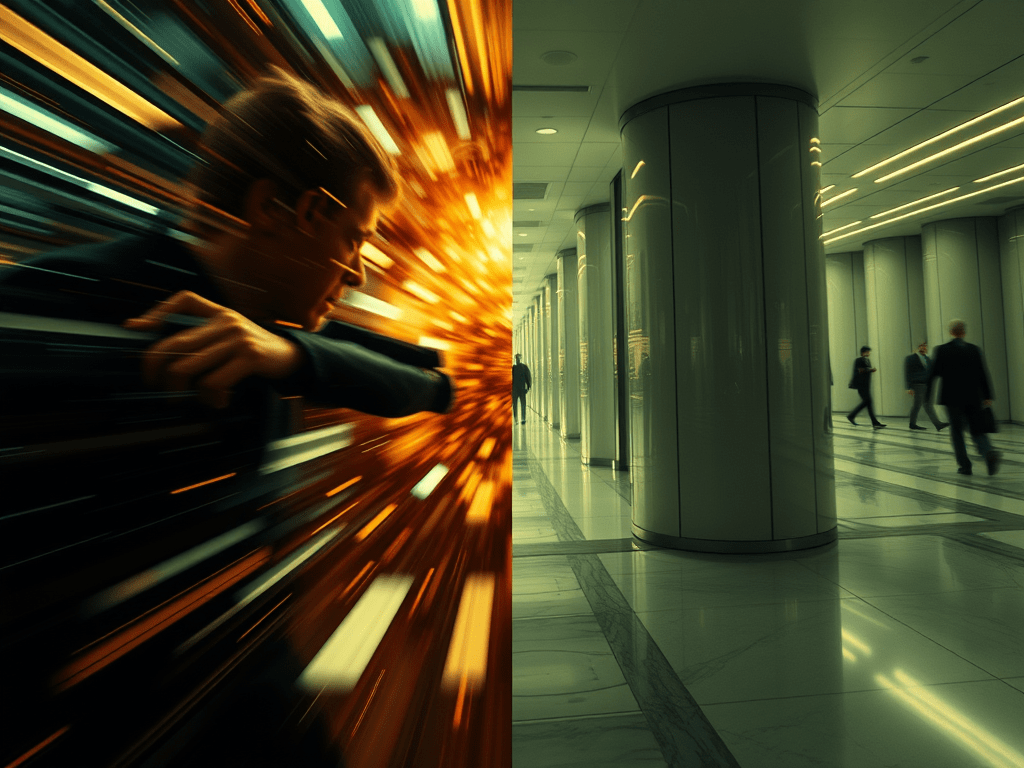
Film editing is the invisible art that shapes narrative, rhythm, and emotion in cinema. By examining two modern classics—The Bourne Identity (2002) and its sequels) and Inception (2010)—we can uncover masterful editing techniques that continue to influence contemporary filmmaking.
The Frenetic Precision of The Bourne Identity
Paul Greengrass’s Bourne sequels revolutionized action editing with their distinctive “shaky cam” style that actually follows meticulous principles:
- Ultra-Short Shot Lengths: Scenes often contain shots lasting less than a second, creating visceral intensity. The famous Berlin car chase in The Bourne Supremacy averages 1.9 seconds per shot, compared to 3-5 seconds in conventional action scenes.
- Purposeful Disorientation: Editors Christopher Rouse and Richard Pearson intentionally break continuity rules, using jump cuts and mismatched angles to place viewers in Jason Bourne’s confused psychological state.
- The “Bourne Flurry”: Rapid-fire sequences of 10-15 frames (less than half a second) provide subliminal information—a gun being drawn, a facial reaction—that the brain registers without conscious processing.
The Architectural Editing of Inception
Christopher Nolan’s dream heist film employs editing as a narrative device:
- Cross-Cutting as World-Building: Editor Lee Smith seamlessly interweaves four simultaneous timelines (real world, van fall, hotel, snow fortress) with distinct rhythms—the van sequence uses longer takes while the hotel fight employs Tony Zhou’s “pillow shot” inserts to maintain spatial awareness during zero-gravity.
- The “Kick” Structure: Each dream level’s climax is precisely synchronized through editing to create the simultaneous “kick” moments, requiring frame-perfect timing across multiple storylines.
- Elliptical Editing: Scenes often begin in medias res (like the opening with Cobb on the beach) using editing to create narrative mystery rather than explanation.
Comparative Insights
While both films use rapid editing, their purposes differ fundamentally. Bourne‘s editing mimics sensory overload and tactical thinking, whereas Inception uses complex cutting to facilitate audience comprehension of layered realities. Interestingly, Bourne sequels average 2,800 cuts per film (≈4 cuts/second during action), while Inception, at 3,200 cuts, spreads them more evenly across dialogue and action.
Takeaways for Editors
- Editing as Psychology: Both films prove editing should serve the protagonist’s mental state—Bourne’s hyper-awareness versus Cobb’s dissolving grip on reality.
- The “Now You See It” Principle: As Bourne editor Christopher Rouse notes: “The audience only needs to see just enough to follow the action, not every punch.”
- Temporal Experimentation: Like Inception‘s stretching time across dream levels, editing can manipulate perceived time through rhythm rather than just chronology.
These films demonstrate that great editing isn’t about flashy transitions but about using pace, juxtaposition and rhythm to deepen storytelling. As Nolan remarked about Inception: “The audience’s mind is the final edit room.” The true art lies in guiding that mental editing process through deliberate cinematic choices.
 Wonder-Ware
Leave a comment