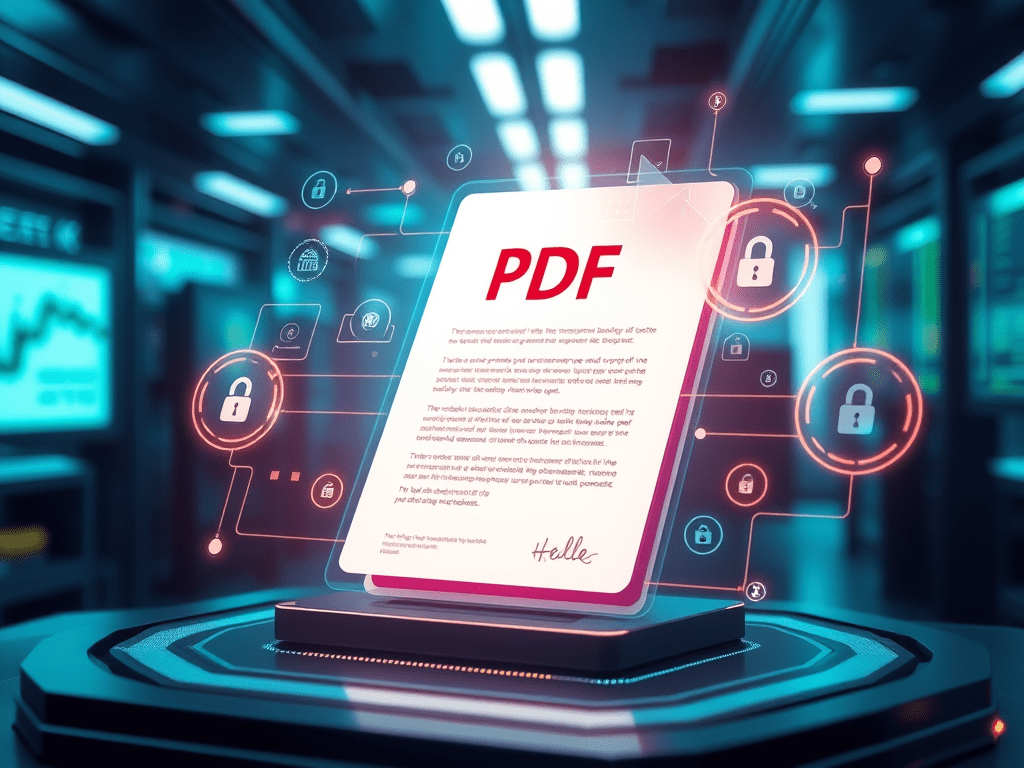
Introduction: The Next Evolution of PDFs
For decades, PDFs have been the standard for secure document sharing. But with the rise of blockchain technology and smart contracts, we’re on the verge of a major transformation. Imagine:
✔ Tamper-proof PDFs with blockchain-verified edits
✔ Self-executing contracts embedded in documents
✔ Decentralized authentication replacing traditional signatures
This isn’t science fiction—it’s the near future of document management. Let’s explore how blockchain will redefine PDF editing.
1. Blockchain-Based Digital Signatures: Beyond Basic eSignatures
Current eSignatures vs. Blockchain Signatures
| Feature | Traditional eSignatures (DocuSign, Adobe Sign) | Blockchain-Based Signatures |
|---|---|---|
| Verification | Relies on centralized providers | Decentralized, cryptographically secured |
| Tamper-Proofing | Limited audit trails | Immutable ledger records every change |
| Revocability | Can be invalidated by provider | Permanent, cryptographically sealed |
How It Works:
- Each signature is hashed onto a blockchain (Ethereum, Hyperledger).
- Any modification breaks the cryptographic link, exposing tampering.
- No need for third-party validators—trust is built into the system.
Use Cases:
✅ Legal contracts (no more “he said, she said” disputes)
✅ Government documents (vote tampering becomes impossible)
✅ Medical records (secure, auditable patient data)
2. Smart Contracts Inside PDFs: Documents That Enforce Themselves
What If Your PDF Could Automate Compliance?
Example: A real estate lease PDF with embedded smart contract logic:
- Rent payment due? → Automatically notifies tenant via email/SMS.
- Late payment? → Triggers a penalty clause (stablecoin transfer).
- Lease expiration? → Locks editing access until renewal.
Tech Stack Behind This:
- PDFs with embedded scripts (JavaScript + blockchain oracles).
- Ethereum/IPFS integration for decentralized storage & logic.
- Zero-knowledge proofs (ZKPs) for privacy-preserving verification.
Industries That Will Benefit:
✔ Legal – Auto-enforcing NDAs, wills
✔ Finance – Self-executing loan agreements
✔ Supply Chain – Audit-proof shipping manifests
3. Decentralized PDF Editing: No More “Final.doc_FINAL(2).pdf”
The End of Version Chaos
Today:
- Email chains with conflicting PDF versions.
- Manual tracking of changes.
Future (with blockchain):
- Every edit is recorded on-chain (like Git for documents).
- Permissioned editing (only approved users can modify).
- Time-stamped revisions (full audit trail).
Example Workflow:
- Alice creates a blockchain-anchored PDF.
- Bob makes edits → recorded as a new transaction.
- Carol approves → smart contract locks final version.
4. Challenges & Roadblocks
Why Isn’t This Mainstream Yet?
❌ Scalability – Blockchains struggle with large PDF storage.
❌ User Experience – Most people don’t use crypto wallets.
❌ Regulation – Laws haven’t caught up with blockchain notarization.
The Solutions Emerging Now:
✔ Hybrid models (blockchain for hashes, cloud for storage).
✔ Wallet-less signing (email-based blockchain verification).
✔ Governance frameworks (like the EU’s eIDAS 2.0).
5. The Future Timeline: When Will This Happen?
- 2024-2025: Early adopters (legal tech, governments) pilot blockchain PDFs.
- 2026-2028: Major platforms (Adobe, DocuSign) integrate blockchain options.
- 2030+: “Traditional” unsigned PDFs seen as outdated and risky.
Conclusion: A Trust Revolution for Documents
Blockchain and smart contracts won’t just improve PDFs—they’ll redefine how we think about:
✔ Authenticity (no more forgery risks)
✔ Automation (documents that manage themselves)
✔ Accountability (every change permanently recorded)
The question isn’t “if” but “when.” Forward-thinking IT leaders should:
- Experiment with blockchain-based signing tools (like DocuSign + Ethereum pilots).
- Monitor regulatory shifts in digital notarization.
- Prepare for smart contract-powered workflows.
The PDF of the future won’t just be a file—it’ll be a verifiable, self-managing digital agreement.
Are you ready? 🚀
(Thoughts? How would YOU use blockchain for PDFs? Let’s discuss in the comments!)
 Wonder-Ware
Leave a comment