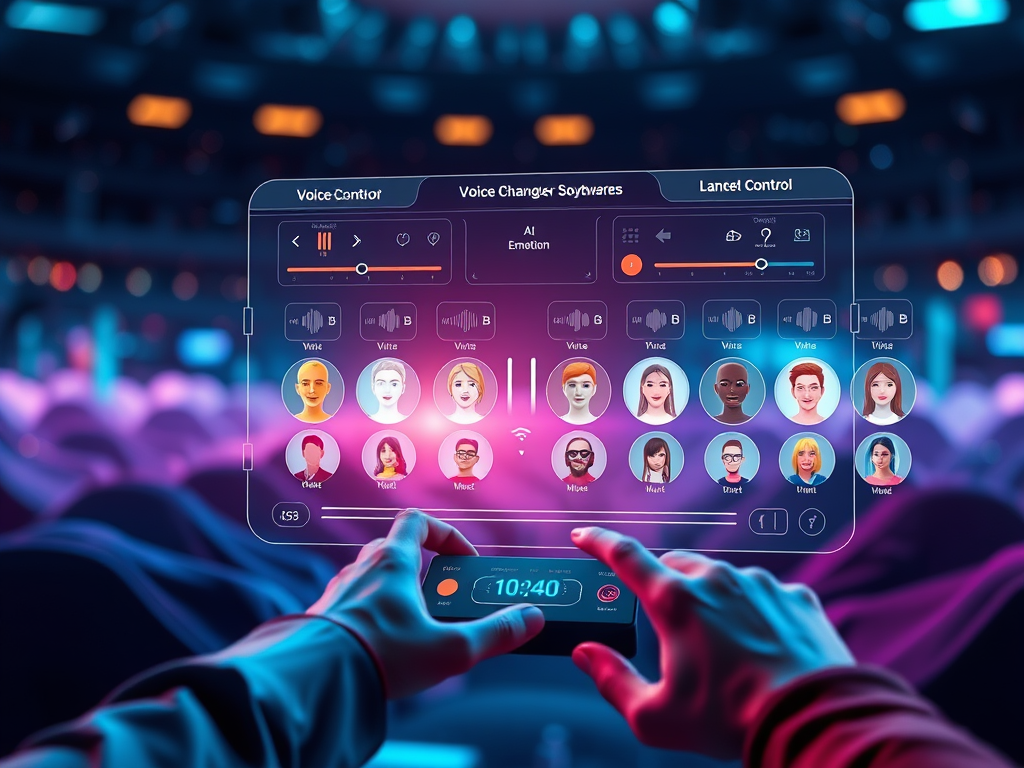
Remember when voice changer software was just a simple tool for pranking friends in games or mimicking movie characters? It’s time to update your perception. With the explosive growth of generative AI and real-time audio processing, voice changing has evolved into a powerful, sophisticated, and imaginative platform by 2025. It is rapidly shifting from entertainment to professional creation, business communication, and even the construction of our digital personas.
If 2024 was the “year of popularization” for AI voice technology, then 2025 is its “year of integration and evolution.” This article explores the three major trends of next-generation voice changer software and their profound implications.
Trend 1: From “Voice Changing” to “Voice Creation” – The Full Dominance of Generative AI
Top-tier voice changer software in 2025 no longer settles for simply adjusting pitch and adding effects. They are built with powerful generative AI voice models, enabling previously unimaginable features:
- Infinite Realistic Voice Libraries: No longer requiring extensive sample training. Just input text, select tags like “Corporate CEO,” “Friendly Nurse,” “Sci-Fi Spaceship AI,” or “Energetic Game Commentator,” and the AI instantly generates a completely original voice that fits the context, brimming with emotion, rather than just modifying your original audio.
- Real-Time Control of Emotion and Tone: True “voice acting” becomes possible. Through simple sliders, users can inject their podcast or video recording with “10% excitement,” “30% sadness,” or “50% authority” in real-time. The AI seamlessly adjusts intonation, rhythm, and pauses, making the output highly expressive.
- Seamless Language and Accent Crossing: Real-time voice changers are beginning to integrate advanced real-time translation and accent simulation. You can speak in Mandarin Chinese, and the output is fluent English with a London or New York accent, largely preserving your original speech melody, drastically lowering the barrier for cross-lingual content creation.
Trend 2: Seamless Integration & Hardware Acceleration – The Ubiquitous “Voice Filter”
The software is no longer a standalone application but becomes an underlying service.
- System-Level Integration: Operating systems (like Windows, macOS) and major communication platforms (Zoom, Discord, Teams) in 2025 are beginning to natively support high-fidelity, low-latency AI audio processing channels. Users can select an “AI Voice Driver” directly in their system audio settings, much like choosing a camera filter, enabling global voice changing without needing to configure virtual audio cables for each individual software.
- The Rise of Dedicated Hardware: To pursue the ultimate real-time效果 (effect) and reduce CPU load, we are seeing the first USB audio interfaces and headphones designed specifically for AI audio processing. They feature built-in NPUs (Neural Processing Units) capable of running large AI voice models locally and offline, ensuring privacy and security while providing a zero-latency experience. They are becoming the new favorite for professional creators and game streamers.
Trend 3: Ethical, Security, and Digital Identity Challenges
The double-edged sword effect of technology is becoming more pronounced in 2025.
- Deepfake Defense Becomes Standard: As voice technology becomes indistinguishable from the real thing, anti-deepfake technology is evolving simultaneously. Industry-leading voice changers are beginning to built-in features like “verifiable voiceprints” or digital watermarks. Users can embed an encrypted marker in the output audio that can be verified by platforms, proving the audio was AI-modified and not an original recording. This is crucial for serious scenarios like journalistic interviews or financial transactions.
- “Digital Voice Personas” & Identity Exploration: In the metaverse and virtual social platforms, voice becomes the soul of the virtual avatar. Users are no longer satisfied with simple voice changing but are meticulously crafting a unique “Digital Voice Persona” that persists across multiple platforms. This becomes a powerful form of self-expression and identity exploration, allowing people to switch between different vocal identities based on their mood or the occasion.
- Establishing Regulations & Consensus: Governments and tech giants are actively discussing and formulating regulations and guidelines for the use of AI-generated audio. The principle of informed consent is becoming an industry baseline. Disclosing the use of voice changing technology during business calls or important meetings is becoming a new digital etiquette.
2025’s Top Voice Changer Software: A Curated Selection
With the landscape evolving so rapidly, here are some of the standout tools that embody the trends of 2025, catering to different needs from creative expression to professional use.
1. Voicemod Pro+ (2025 Edition)
- Best For: Gamers, Streamers, and Content Creators
- Why it Stands Out: A veteran in the space, Voicemod has fully embraced generative AI. Its 2025 edition features a powerful “AI Voice Lab” where you can generate entirely new voices from text descriptions. It offers unparalleled system-level integration on Windows, making it effortless to use in any game, Discord, or streaming software like OBS. Its new “Emotion Engine” sliders for real-time tone adjustment set a new standard for live performance.
- Key 2025 Feature: Offline AI Processing Mode ensures your voice data remains private during sensitive gaming sessions or streams.
2. Voice.ai Generative Voice Studio
- Best For: Podcasters, Video Editors, and AI Enthusiasts
- Why it Stands Out: This cloud-based platform is at the cutting edge of voice generation. It’s less about real-time changing and more about high-quality, studio-level voice creation and cloning. Its extensive community-driven voice library allows you to discover and use voices from thousands of characters and personalities. Perfect for pre-producing podcast intros, dubbing videos, or creating narrative content.
- Key 2025 Feature: Cross-lingual Voice Conversion allows you to record in your native language and output a high-quality version in another, perfectly matching the lip-sync timing for video.
3. Murf AI Enterprise Suite
- Best For: Businesses, Elearning Developers, and Corporate Communications
- Why it Stands Out: Murf has positioned itself as the go-to professional tool. It focuses on generating studio-quality voiceovers from text, but its 2025 real-time plugin is a game-changer for virtual presentations and trainings. It offers the most realistic and trustworthy “Corporate” voice styles and excels at adding emotion and emphasis to dry script reading.
- Key 2025 Feature: “Ethical Mode” with Verifiable Watermarks automatically embeds inaudible digital signatures in all audio outputs, making it ideal for companies concerned with authenticity and deepfake prevention.
4. Replica Studios (Integrated with Game Engines)
- Best For: Game Developers and Animators
- Why it Stands Out: Replica is deeply integrated into development environments like Unreal and Unity. It allows developers to generate dynamic, character-specific dialogue in real-time, reacting to player choices without pre-recording every line. It represents the future of interactive media and storytelling.
- Key 2025 Feature: Real-time Emotion & Direction Scripting lets developers adjust vocal performance on the fly with code, e.g.,
character.speak(line, emotion="angry", intensity=0.8).
5. Adobe Voco (Beta – Part of Adobe Creative Cloud)
- Best For: Creative Professionals already in the Adobe ecosystem
- Why it Stands Out: Long a rumored project, “Project Voco” appears to be launching in 2025 as a integrated tool within Adobe Premiere Pro and Audition. It uses Adobe’s Sensei AI to offer text-based speech editing and voice generation that perfectly matches the audio quality and workflow of video editors. Imagine typing a word to fix a mispronunciation or generating a voiceover that perfectly matches the tone of your documentary.
- Key 2025 Feature: Seamless Workflow Integration with Premiere Pro for fixing audio errors and generating narrations without ever leaving the editing timeline.
A Note on Hardware: For serious users, look into devices like the AI Voice Modulator USB from companies like TC Helicon or Elgato. These dedicated hardware units handle processing onboard, freeing up your computer’s CPU and guaranteeing zero-latency, broadcast-quality voice modulation.
How to Choose in 2025?
With these evolutions, the criteria for choosing a tool have also changed:
- Privacy-First: Prioritize software that offers a complete offline processing mode, ensuring your original voice data is never uploaded to the cloud.
- Ecosystem Compatibility: Check if it supports system-level audio drivers (like Windows GAME DRIVER) and seamless integration with your most-used software (OBS, Discord, DAWs).
- Forward-Looking Features: Does it support emotional control? Does it provide verifiable output? These will be key differentiators between a simple toy and a professional tool.
- Hardware Readiness: Evaluate if your computer has sufficient AI processing power (e.g., a modern NPU), or consider investing in dedicated AI audio hardware for the best experience.
Conclusion
Voice changer software in 2025 has long surpassed the category of mere “voice changing.” It is a pivotal creative AI technology redefining the boundaries of human-computer interaction, content creation, and online socializing. It empowers everyone to become a “sound designer,” while also presenting us with new questions about authenticity, trust, and digital ethics.
Embrace this era of shaping the future with voice, but be sure to bring along thoughtfulness and responsibility.
 Wonder-Ware
Leave a comment